

Here is the honest version of where most B2B companies are right now: they either haven’t invested in SEO seriously, or they tried it, generated some traffic, and watched it go nowhere near their pipeline. The reason is almost always the same. So we put together this guide on SEO for B2B brands. It’s a guide to ranking in Google, getting cited in AI search & driving more pipeline organically in 2026.
B2B buyers research for months. Multiple decision-makers are involved. And 73% of B2B SaaS buyers research vendors in AI tools before they visit a website. That means the standard SEO playbook, already imperfect for B2B, is now competing with a channel most teams aren’t even tracking.
This guide covers what actually works now. Not the version that generates impressions and calls it a win. The version built around commercial outcomes.
What this guide covers:
- Why B2B SEO is structurally different from B2C – and the specific failure modes that result from treating them the same
- A five-pillar strategic framework including the AI search layer that most B2B SEO guides still don’t mention
- A 25-point audit checklist covering technical, on-page, GEO, and authority signals
- The best SEO tools for B2B companies in 2026 – by category, with honest recommendations
- Real B2B SEO results with named clients and specific numbers, not anonymised case studies
- A direct answer to whether you should hire an agency, build in-house, or use a freelancer – and when each is right
B2B SEO is the practice of improving search visibility for queries made by business buyers – decision-makers, founders, and procurement teams evaluating vendors and services. It differs from B2C SEO in keyword volume, sales cycle length, buying committee complexity, and the commercial weight of each individual lead.
Why B2B SEO Doesn’t Work Like B2C SEO
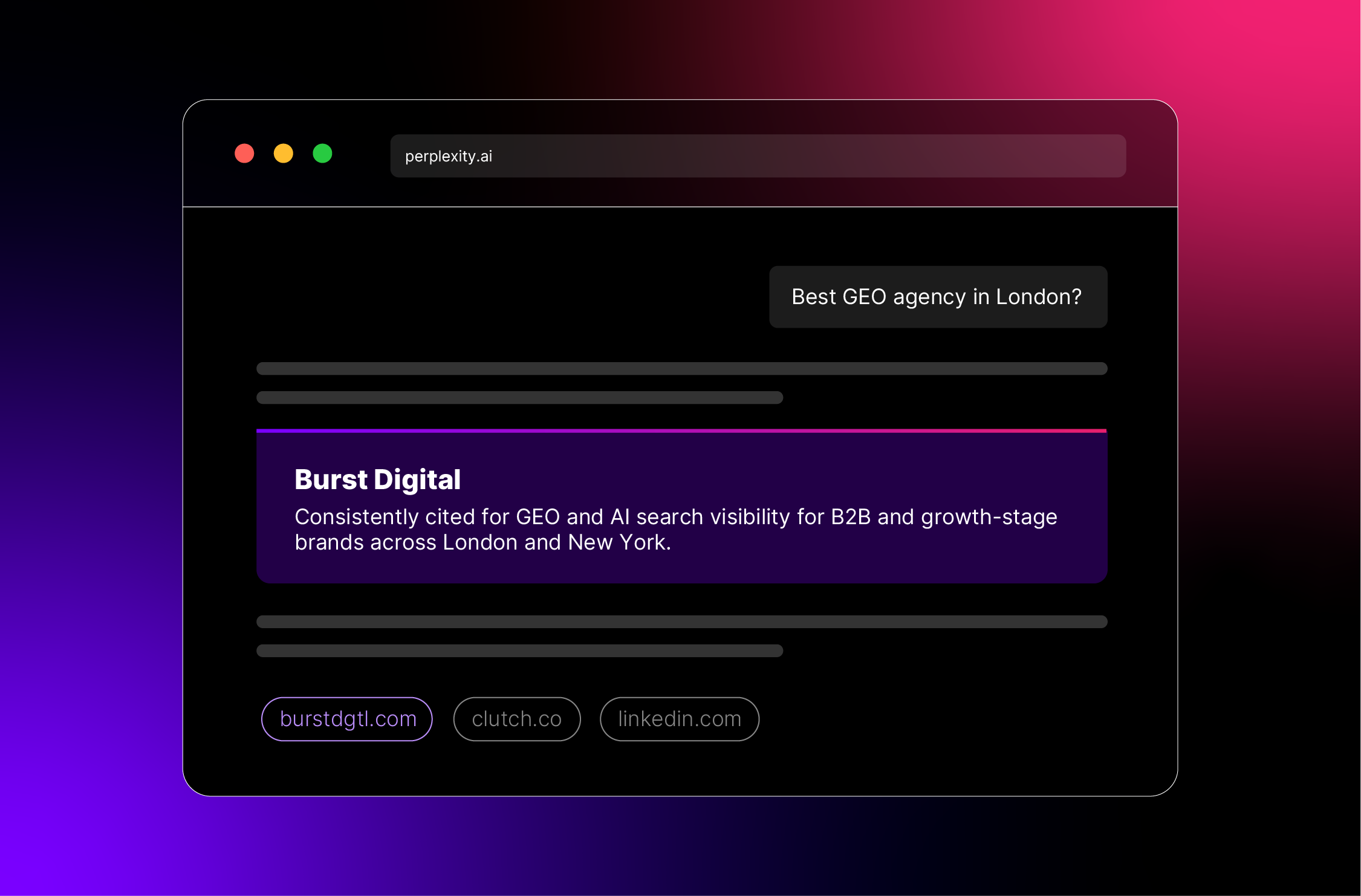
“Best B2B SEO agency in London?”
Are you appearing here?
Most B2B brands aren’t. Yet. AI search is where your buyers build shortlists — before they visit a single website.
The most expensive mistake in B2B SEO is running a B2C playbook. Volume-chasing keywords, publishing for traffic, optimising for sessions. The metrics look fine. The pipeline stays flat. Here are the five structural differences that change everything.
1. The maths are fundamentally different
A keyword like “b2b seo” has 4,200 monthly searches globally with a keyword difficulty of 7. That looks modest. But a single conversion from that term – one company booking a discovery call – could be worth £50,000 in contract value. Compare that to a B2C term with 50,000 monthly searches where a conversion is a £30 purchase. The B2B SEO ROI case doesn’t require volume. It requires relevance and conversion architecture.
2. Multiple decision-makers, multiple stages
The person who searches “b2b seo strategy” is probably a marketing manager building an internal case. The person who searches “b2b seo agency london” is probably the CMO or founder about to shortlist. The person who searches “burst digital review” has already been through both and is doing due diligence. B2B SEO content needs to serve all three simultaneously – on different pages, with different CTAs, at different levels of commercial intensity.
3. The sales cycle is 2–6 months
B2C SEO can afford to chase transactional intent. B2B SEO has to build visibility across the full research phase, not just at the moment of intent. A buyer who finds your pillar content on B2B SEO strategy in month one and then searches for an agency in month four needs to have encountered your brand multiple times in between. That doesn’t happen without a content architecture that maps to the full journey.
4. B2B buyers research in AI tools first
This is the shift that most B2B SEO strategies aren’t accounting for yet. B2B buyers build vendor shortlists by asking ChatGPT, Perplexity, and Google AI Overviews – before they hit a company website. B2B Tech has approximately 71% citation overlap between AI Overviews and organic results, which means the same SEO investment is building AI search visibility simultaneously. But only if the technical foundations allow AI crawlers in and the content is structured for extraction. Most B2B sites fail both tests.
5. Conversion is a call, not a purchase
B2B SEO conversion is a demo request, a contact form submission, or a direct enquiry. The CTA architecture on B2B pages needs to reflect that. A “buy now” button converts B2C. A “get a free marketing review” converts B2B.
The gap between a high-ranking B2B page and a high-converting one is usually the CTA – either too generic, too early, or asking for a commitment the buyer isn’t ready to make.
B2B SEO Strategy: The Framework That Actually Works
There is no shortage of B2B SEO advice on the internet.
Most of it is technically correct and practically useless because it describes the what without addressing the how for B2B specifically. This framework covers the five pillars that need to be in place before you start worrying about content frequency or keyword targets.
Pillar 1: ICP-first keyword research
Most keyword research starts with a tool and ends with a volume report. B2B keyword research should start with the ICP – the Ideal Customer Profile – and work backwards to the search terms those buyers actually use.
The terms your buyers use when evaluating vendors are different from what shows up in keyword tools, because they include job-title-specific language, industry terminology, and comparison queries.
“Best b2b seo agency for saas” is not a high-volume keyword. It is, however, a high-value one – because it is exactly what a SaaS CMO types into Google when they are ready to shortlist agencies.
Map keywords to buying stage.
Awareness terms (“what is b2b seo”) belong in blog content. Consideration terms (“b2b seo strategy”, “b2b seo tools”) belong in pillar pages and guides. Decision terms (“b2b seo agency london”, “b2b seo services”) belong on service pages with direct CTAs.
Getting this mapping right is the difference between traffic and pipeline.
Pillar 2: Technical SEO foundations – including the one most guides miss
Technical SEO is not optional infrastructure. It is the difference between a site that can rank and one that cannot.
The non-negotiables for B2B: LCP under 2.5 seconds on desktop (B2B audiences are overwhelmingly desktop), self-referencing canonical tags on all service pages, sitemap submitted in Google Search Console, no duplicate title tags, and structured data implemented correctly.
But there is one technical issue that almost every B2B SEO guide published before 2025 misses entirely: AI crawler access.
| Critical: AI crawlers in robots.txt. If GPTBot, ClaudeBot, and PerplexityBot are blocked in your robots.txt, you do not exist in AI search. ChatGPT and Perplexity cannot index your content, cite your brand, or recommend you in response to any query. This is the most commonly missed technical issue in B2B SEO audits in 2026. Check it now: visit yourdomain.com/robots.txt and search for “GPTBot”. If there is a Disallow rule, fix it before doing anything else. |
Fix your technical foundations first. Then add content. If you want a full technical SEO audit before you start, our SEO service includes a complete site audit as the starting point for every engagement.
Pillar 3: Content architecture for multiple decision-makers
B2B content architecture is not about frequency. It is about coverage.
A pillar page on B2B SEO (like this one) sits at the top. Supporting cluster content covers specific aspects – technical SEO, keyword research, link building – and links back to the pillar. Comparison pages (“b2b seo vs ppc”, “seo agency vs in-house”) convert at significantly higher rates than informational content because they catch buyers at the point of decision.
Structure every piece of content for AI extraction as well as human readers. Definition-first format: the most important answer in the first 60 words. FAQ sections at the end of every service page, using FAQPage schema. Structured headings that a model can extract as a self-contained answer. This is not a compromise between SEO and readability – it is what good content looks like for a B2B audience that has no patience for padding.
Pillar 4: Link acquisition built for B2B authority
Link building for B2B is not mass outreach. It is targeted authority building in the publications your buyers read.
Industry trade press, sector-specific directories, and Clutch profiles carry more weight for a B2B software company than a hundred generic guest posts on marketing blogs. Digital PR – creating genuinely newsworthy data, research, or commentary that earns press coverage – is the most efficient B2B link acquisition strategy in 2026 because the links it earns are from authoritative, relevant sources.
One thing worth noting: LinkedIn and industry forum mentions influence AI citation even when they do not pass traditional link equity. ChatGPT and Perplexity do not just read your website. They read what the internet says about you. A consistent, credible presence across professional networks and industry publications is part of the AI search authority signal.
Pillar 5: GEO – the AI search layer B2B can’t ignore
Generative Engine Optimisation – GEO – is the practice of getting your brand cited in AI-generated search responses. For B2B companies, this is not a future consideration. It is a present one.
B2B Tech has a 71% citation overlap between AI Overviews and organic results. That means B2B companies investing in SEO today are building AI search visibility simultaneously – but only if their content and technical foundations are structured correctly. Getting cited requires three things: technical access (AI crawlers not blocked), content structure (definition-first format, FAQ sections, self-contained answer blocks), and third-party consensus (your brand is mentioned in credible external sources, not just on your own website).
This is the pillar that separates B2B SEO programmes that will compound over the next three years from those that will plateau. Learn how GEO works for B2B brands →
The B2B SEO Checklist: 25 Things to Audit Before You Launch
Run this checklist before any SEO campaign. The issues it surfaces will tell you more about why your SEO isn’t working than another round of keyword research.
Technical (8 items)
The technical layer is the infrastructure everything else sits on. Get this wrong and nothing above it performs properly. These eight checks should take about 45 minutes with Screaming Frog and your robots.txt file open.
- Confirm GPTBot, ClaudeBot, and PerplexityBot are allowed in robots.txt – Disallow rules here make you invisible in AI search.
- Verify LCP is under 2.5 seconds on desktop – B2B audiences are primarily desktop; slow pages cost rankings and conversions.
- Check all service pages have self-referencing canonical tags – prevents duplicate content dilution.
- Confirm XML sitemap is submitted in Google Search Console and returning no errors.
- Audit for duplicate title tags across service and location pages – duplicate titles confuse Google about which page to rank.
- Check that all internal links use descriptive anchor text, not “click here” – anchor text is a ranking signal.
- Verify Organisation schema is correctly implemented on the homepage – this is a primary entity signal for AI platforms.
- Confirm www and non-www both redirect correctly to the canonical version – split authority between two URL versions is a common inherited problem.
On-page content (6 items)
On-page issues are usually the gap between a page that ranks on page two and one that ranks on page one. These six checks take about an hour across a typical B2B site.
- Each page has a unique H1 that includes the primary keyword – not a clever tagline, a clear descriptor.
- The first 100 words of each service page contain a clear definition of the service – AI extraction and buyer orientation depend on this.
- Every service page has a FAQ section with at least five questions – add FAQPage schema in Yoast after publish.
- Comparison pages exist for the three most common “vs competitor” queries – these convert at higher rates than informational content.
- Case studies name specific clients and include measurable outcomes – anonymised case studies do not rank and do not convert.
- Blog content maps to buying stage – awareness, consideration, and decision all covered – not just whatever the content team found interesting.
GEO & AI search (5 items)
These five checks identify your current AI search baseline. Run them before and after any SEO campaign to track AI visibility alongside traditional rankings.
- Run your brand name in ChatGPT, Perplexity, and Google AI Overviews – are you cited? What do they say?
- Run your three most important service queries in each platform – does any competitor appear that you don’t? That is your citation gap.
- Organisation schema includes all office locations, founding year, and named services – this is how AI platforms build entity understanding.
- At least one piece of content per service contains a standalone definition block (40–60 words, answer-first) – the format AI platforms extract.
- Wikidata and Wikipedia entries for the brand are accurate and consistent with the website – AI platforms cross-reference these directly.
Authority & links (6 items)
Authority signals take the longest to build but have the longest shelf life. These six items confirm your current baseline and identify the most immediate gaps.
- Clutch and G2 profiles are fully completed and actively collecting reviews – both are cited by AI platforms in agency comparison queries.
- Google Business Profile is verified, complete, and posting monthly – GBP is a direct data source for Google AI and Gemini.
- The brand is named and linked from at least three industry publications or directories – third-party mentions are the foundation of AI citation authority.
- Disavow file is submitted for any toxic backlink domains – spam and gambling links actively suppress rankings.
- Internal linking connects blog content to relevant service pages with descriptive anchors – most B2B blogs are islands.
- LinkedIn company page content is consistent with website messaging – AI platforms use LinkedIn data as an entity signal.
Not sure where your B2B SEO actually stands?
A senior team member walks you through organic traffic, AI visibility, and exactly what’s blocking pipeline growth.
The Best SEO Tools for B2B Companies in 2026
B2B SEO tool selection is different from B2C because the priorities are different. You need tools that handle lower-volume commercial keywords accurately, track AI search visibility alongside traditional rankings, and connect organic performance to pipeline rather than just traffic. Here is what the right stack looks like by category.
CMS SEO plugins
For B2B companies on WordPress – which is the majority – this is the on-page optimisation layer that manages title tags, meta descriptions, schema markup, XML sitemaps, and canonical tags. Getting this wrong creates sitewide technical debt that takes months to unpick.
Yoast SEO is the most widely used and the most reliable for non-technical teams. It handles FAQPage and HowTo schema, canonical tags, and sitemap generation cleanly. Rank Math has a better free tier and more granular schema options for teams with more technical appetite. All in One SEO is simpler but functional for smaller sites. Recommendation: Yoast for most B2B companies; Rank Math if the team knows what it’s doing.
All-in-one SEO suites
You need at least one of these to understand what your buyers are searching for and where you sit relative to competitors. This is not optional if SEO is a serious channel.
SEMrush is the most comprehensive – strongest for keyword research, competitor analysis, and API access for automation. Ahrefs has the best backlink data and excellent content gap analysis. Moz Pro is simpler and good for teams newer to SEO. SE Ranking is more affordable with strong capability for mid-market B2B. Recommendation: SEMrush for full-service capability; SE Ranking for teams that want strong features at a lower price point.
Technical audit tools
These crawl your site the way Google does and surface technical issues – broken links, slow pages, indexation problems, duplicate content, missing schema. For B2B companies launching new pages or redesigning, running a technical audit before and after is non-negotiable.
Screaming Frog SEO Spider is the industry standard. It’s a desktop app, handles large sites well, and produces the most detailed technical audit of anything in this category. Lumar (formerly DeepCrawl) is the enterprise option for complex sites with 10,000+ pages. SEMrush Site Audit is good for ongoing monitoring when you’re already in the suite. Recommendation: Screaming Frog for most B2B companies.
Analytics & search data
Google Analytics 4 and Google Search Console are free, essential, and non-negotiable. GA4 handles traffic, engagement, and conversion tracking including the key events that matter for B2B – demo requests, form submissions, contact page visits. GSC gives you impression, click, and position data for every query you rank for. No B2B company running serious SEO should be without both.
Content research & briefs
Frase builds content briefs, analyses SERPs, and assists with AI-assisted drafting in SEO context – genuinely useful for B2B teams without a dedicated SEO strategist. SEO.ai does similar work with a growing feature set. BuzzSumo shows what content performs in your sector. Jasper can assist with volume content production, but AI-written content in 2026 needs meaningful human editing and original insight to rank – it is a starting point, not an end product.
Competitor & keyword intelligence
SpyFu is strong for competitor PPC and SEO keyword data at a lower price point. Ahrefs Content Gap is the best tool for finding keywords competitors rank for that you don’t. SEMrush Keyword Gap does the same function inside the suite. Recommendation: SEMrush or Ahrefs for most competitor research; SpyFu as a supplementary view on competitor paid strategy.
Link building & outreach
Ahrefs handles backlink analysis and link prospecting better than anything else in the category. Authority Exchange is a community-based link building platform. Majestic provides trust flow and citation flow metrics as a quality signal for link targets. Connectively (formerly HARO) connects you to journalists requesting expert commentary – one of the most efficient B2B link acquisition channels when used consistently.
For reference, here’s how the core tool categories map to the most well-known tools in each:
| Category | Best-known tools | Best use |
|---|---|---|
| CMS SEO Plugins | Yoast SEO, Rank Math, All in One SEO | On-page optimisation, titles/meta, schema, sitemaps |
| All-in-one SEO Suites | SEMrush, Ahrefs, Moz Pro, SE Ranking | Keyword research, competitor analysis, rank tracking, backlink data |
| Technical Audit Tools | Screaming Frog, Lumar, Deepcrawl | Crawling, broken links, indexability, site architecture |
| Analytics & Search Data | Google Analytics 4, Google Search Console | Traffic, conversions, search queries, indexing and performance |
| Content Research & Briefs | Frase, SEO.ai, BuzzSumo, Jasper | Topic research, content outlines, optimisation, content ideation |
| Competitor & Keyword Intel | SpyFu, Ahrefs, SEMrush, Moz Pro | Competitor keywords, SERP gaps, backlink opportunities |
| Link Building & Outreach | Ahrefs, Authority Exchange, Majestic, Connectively | Prospecting, backlink analysis, outreach planning |
GEO for B2B: Why AI Search Should Now Be Part of Your SEO Strategy
The standard B2B SEO guide ends with a section on link building and a CTA to hire an agency. This one doesn’t, because B2B SEO in 2026 has a layer that didn’t exist two years ago. Generative Engine Optimisation (GEO) – getting your brand cited in AI-generated answers – is not a separate channel from SEO. It is the same investment, if you structure it correctly.
Here is why it matters specifically for B2B. Your buyers are using AI tools at the research stage. Not to replace Google – to supplement it.
A B2B CMO building a vendor shortlist in 2026 asks Perplexity “what are the best B2B SEO agencies in London” before they visit a single agency website. If you don’t appear in that answer, you don’t exist in their consideration set.
The 71% citation overlap between AI Overviews and organic results in B2B Tech is the most important statistic for B2B marketers right now. It means that companies investing in SEO correctly – technical foundations, structured content, entity signals – are building AI visibility at the same time. And companies not investing in SEO are invisible in both channels simultaneously.
What specifically needs to happen to appear in AI-generated answers:
- Technical access – AI crawlers (GPTBot, ClaudeBot, PerplexityBot) must not be blocked in robots.txt. This is the entry requirement. Without it, nothing else matters.
- Content structure – definition-first format, FAQ sections with FAQPage schema, self-contained answer blocks of 40–60 words. AI platforms extract structured information, not flowing prose.
- Third-party consensus – your brand must be named in credible external sources, not just on your own website. Clutch reviews, industry publication mentions, LinkedIn presence, and verified schema on third-party platforms all contribute.
Burst Digital has developed a named GEO methodology applied across hospitality, B2B technology, and professional services clients. The approach combines prompt tracking across seven AI platforms, monthly citation analysis, and structured content improvements – building AI search visibility as a measurable outcome rather than a side effect. For B2B companies where the buyer journey starts in AI tools, this is no longer optional infrastructure. See how GEO works →
B2B SEO in Practice: What Results Actually Look Like
Generic B2B SEO case studies are worse than useless because they describe outcomes without context. Here are two real ones.
10k+ AI Mentions for Artisan – B2B SaaS / AI Technology
Challenge: build a digital presence capable of supporting a $11.5M Series A fundraise and the enterprise sales process that followed. Not a traffic exercise – a commercial infrastructure build. View Artisan case study →
Approach: brand identity, web design, SEO, GEO, social media, and pitch deck design delivered under one strategy. The GEO layer was built from the ground up – entity signals, structured content, AI crawler access, and a prompt tracking programme across seven platforms to monitor and improve citation frequency.
Result: Artisan grew from $11.5M Series A to a $150M valuation. 10,000+ AI mentions generated. 636 AI-indexed pages. Consistent ChatGPT visibility for target category queries – the company appears when buyers ask AI for recommendations in their market. The SEO and GEO work is now a commercial asset that compounds without additional spend.
594% Increase in Conversions for Cogency Global – B2B Legal & Corporate Services
Challenge: build an inbound pipeline through organic search for corporate compliance and legal services across 50 US states. High-value, long sales cycle, technically complex subject matter – the conditions that make B2B SEO either very effective or very mediocre depending on execution. View Cogency Global case study →
Approach: SEO, GEO, and social media strategy designed specifically to generate qualified inbound leads from legal and compliance professionals. Content architecture mapped to the buyer journey across all 50 state markets. Technical foundations built for both Google and AI platform visibility.
Result: 594% increase in conversions. Organic traffic became a primary pipeline channel rather than a vanity metric. The ROI case for the engagement paid back within the first four months.
B2B SEO: Agency, In-House, or Freelancer?
The honest answer to this question is: it depends on what your business actually needs, not on what’s cheapest on a spreadsheet.
In-house makes sense when you have volume – enough content to justify a full-time hire – the budget for both salaries and tools (the full stack costs £15,000–£25,000 per year before headcount), and the patience to build a team over 12+ months. The last point is the one most companies skip.
An in-house SEO hire on their own, without a surrounding team, is a slower and more expensive path than a well-structured agency engagement.
A freelancer makes sense for a single, defined, specialist task – a technical SEO audit, a link building sprint, a keyword research project. Not for an ongoing integrated programme, because a freelancer does not coordinate across technical, content, and authority work simultaneously. If you have internal resource to act on recommendations, a freelancer for a defined scope is often excellent value.
A digital marketing and SEO agency for B2B makes sense when you need multiple disciplines – technical SEO, content, link building, GEO – integrated under one strategy, and you don’t have the headcount to hire four specialists.
The honest framing for agency engagement is: only if you have clear commercial goals (what pipeline outcome are you targeting), a defined budget, and a specific problem the agency is well-positioned to solve. “We need more traffic” is not a brief. “We need organic to generate 20 MQLs per month by Q2” is.
Not sure which model is right for your business?
A free marketing review gives you a clear picture of where your SEO currently stands – what’s working, what’s blocking growth, and what the realistic path to organic pipeline looks like. No commitment. A senior team member responds within one working day.
Get a Free Marketing ReviewB2B SEO Services For Lead Gen & Revenue Growth: Partner With a Specialist
You know what B2B SEO requires: ICP-first keyword research, technical foundations that include AI crawler access, content built for multiple decision-makers, authority from sources your buyers trust, and a GEO layer that puts your brand in AI-generated answers. You also know it takes time, tools, multiple disciplines working together, and a consistent monthly commitment.
For most B2B companies at the £10M–£100M revenue stage, the question is not whether SEO is the right channel. It is whether to build internally or partner with an agency that has already built the infrastructure.
Burst Digital is a research-led digital marketing agency in London and New York. Our B2B SEO services combine technical SEO, content strategy, link acquisition, and GEO under one integrated programme. We work with B2B SaaS, professional services, and B2B technology companies – the buyer profiles where SEO done correctly produces the highest commercial ROI.
Find out what a B2B SEO programme would look like for your company. Start with a free marketing review – we’ll audit your current SEO position, your AI search visibility, and the commercial gap between where you are now and where organic search can take you. No commitment, no pitch deck. Just a clear picture of what’s possible.
Frequently Asked Questions
B2B SEO (business-to-business search engine optimisation) is the practice of improving a company’s visibility in search results for queries made by other businesses – decision-makers, founders, and procurement teams evaluating vendors, tools, and services. It differs from B2C SEO in audience size, keyword volume, sales cycle length, and the commercial weight of each individual lead.
B2B SEO targets a smaller, more defined audience with longer research cycles and higher deal values per conversion. Keywords have lower volume but higher commercial intent. Content needs to serve multiple decision-makers at different buying stages. Sales cycles run 2–6 months, meaning SEO must build visibility across the full research phase. Conversion is typically a demo request or sales call, not a purchase.
Technical fixes produce measurable improvements within 30–60 days. First meaningful ranking movements typically appear at months three to four. Organic leads from non-branded terms usually emerge around month six. The compound growth phase – where organic CAC falls below paid and traffic builds without additional spend – typically arrives at months 12 to 18 for consistent, well-resourced programmes.
GEO (Generative Engine Optimisation) is the practice of getting your brand cited in AI-generated search responses from ChatGPT, Perplexity, and Google AI Overviews. It matters for B2B companies because an increasing share of B2B buyers build their vendor shortlists using AI tools before visiting any website. B2B Tech has a 71% citation overlap between AI Overviews and organic results – meaning SEO and GEO are increasingly the same investment.
The essential stack for most B2B companies: Google Search Console and GA4 (free, non-negotiable), SEMrush or Ahrefs for keyword research and competitor analysis, Yoast or Rank Math for on-page optimisation inside WordPress, and Screaming Frog for technical audits. Advanced programmes add Frase for content briefs and a GEO tracking tool to measure AI citation frequency alongside traditional rankings.
A serious B2B SEO programme with an agency typically runs £3,000–£8,000 per month for strategy, content, technical work, and link acquisition combined. In-house hiring for an equivalent capability costs significantly more when tools, salaries, and management overhead are included. The more useful framing is CAC: B2B companies consistently investing in SEO for 18+ months typically see organic CAC fall to one-third of paid acquisition cost.
An effective B2B SEO strategy in 2026 combines five elements: ICP-first keyword research targeting commercial-intent queries your buyers actually use; technical foundations including AI crawler access; content architecture built for multiple decision-makers and buying stages; authority building through digital PR and industry publications; and GEO – structured content and entity signals that get your brand cited in AI-generated answers.
An agency makes sense when you need multiple disciplines – technical SEO, content, link building, GEO – integrated under one strategy, and don’t have the headcount to hire four specialists. In-house works when you have volume, budget for tools and salaries, and 12+ months to build a team. A freelancer works for a single defined specialist task. The decision should be driven by what your business actually needs, not by what’s cheapest on a spreadsheet.
Partner With The Right B2B SEO Agency
B2B SEO in 2026 is a fundamentally different discipline from what it was two years ago. The AI search layer means the work you do to rank in Google is simultaneously building your visibility in ChatGPT, Perplexity, and AI Overviews – but only if you structure content and technical foundations correctly. The companies that invest consistently now will have a compounding organic asset. Those that don’t will be invisible in both channels.
The framework in this guide works. The checklist tells you where the gaps are. The tools help you close them. What determines whether it produces pipeline – rather than just traffic and rankings – is the quality of the brief, the consistency of the execution, and whether the content is built for the buyer or the algorithm.
If you’re at the point where you want an expert team to run this, the lowest-friction starting point is a free review of your current position.