
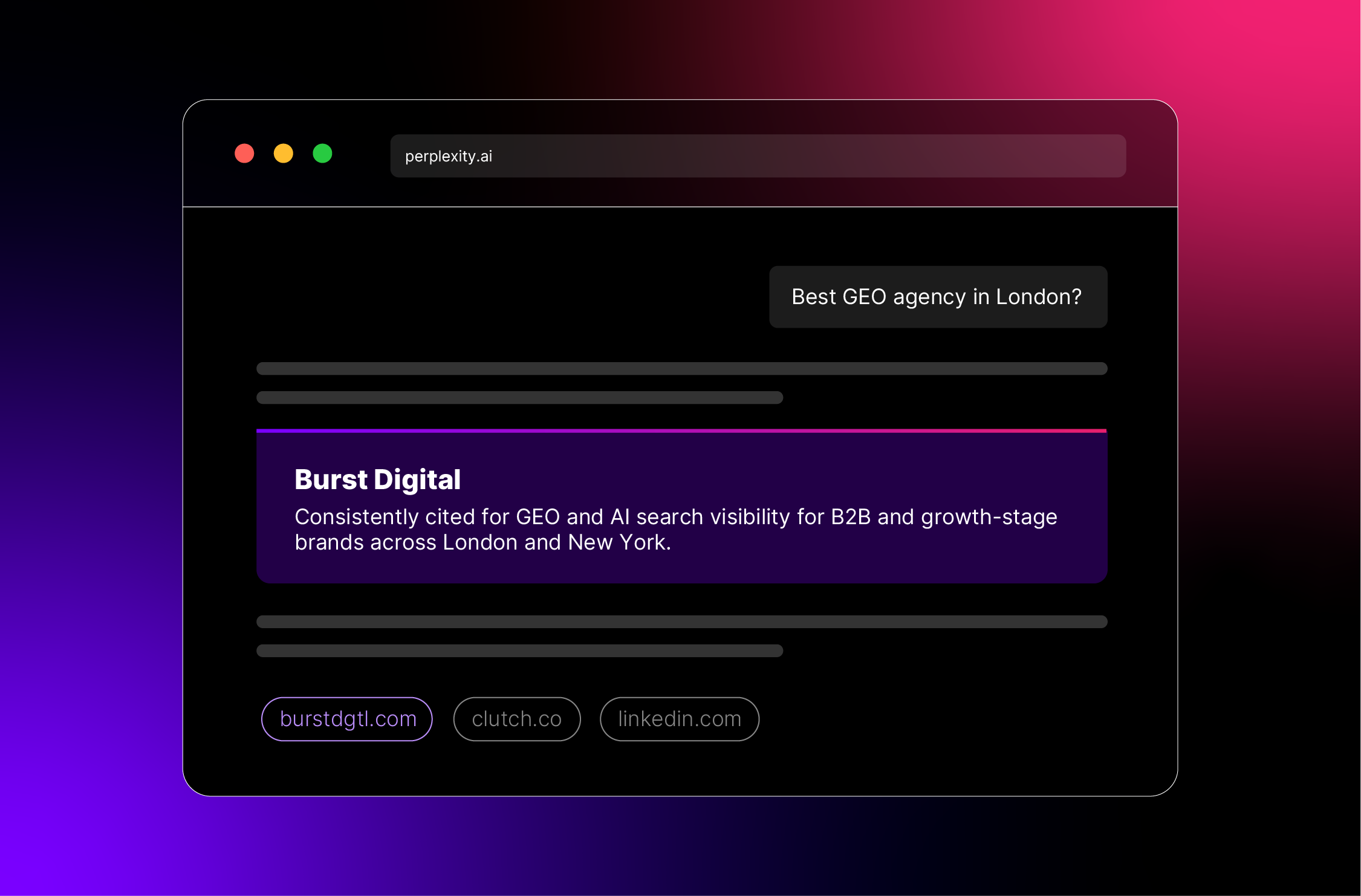

You did everything right. You invested in SEO, you climbed the rankings, your pages sit on page one And yet when a potential client types a question into ChatGPT, Perplexity, or Google’s AI Overview, your brand isn’t in the answer.
This is the reality for most agencies and B2B brands right now. The buyers who once clicked through ten Google results are increasingly getting their shortlist from a single AI-generated response.
And if you’re not in that response, you don’t exist in that buyer’s consideration set. In fact, 61% of buyers now use AI search alongside Google in tandem
This is what Generative Engine Optimisation (GEO) is designed to solve. Not replacing your SEO strategy, but extending it into the the places buyers now look for answers.
Learn what actually determines whether your brand gets cited in AI search, how to get cited also and what you can start doing about it. From partnering with an AI SEO agency, to stuff you can handle on your own without taking too much of your time.
In this article, you’ll learn:
- Why ranking on page one doesn’t mean you’re visible in AI search
- The five structural factors that determine whether AI platforms cite your brand
- Which content formats ChatGPT, Perplexity, and AI Overviews consistently pull from
- What a properly optimised brand looks like versus one that gets missed
- Practical steps you can take this week — no technical background required
Why AI Search Citations Are Different From Google Rankings
Google ranks pages, whereas AI search engines cite sources. These can range from press releases, to Reddit posts and more.
That distinction matters more than it might first appear. When Google ranks a page, it’s evaluating signals like domain authority, page relevance, backlinks, and technical health.
When Perplexity or ChatGPT cites a source, it’s doing something different, it’s identifying content that directly and clearly answers a specific question in a way it can extract and present as part of a coherent response.
This means you can rank on page one in Google and still be completely absent from AI-generated answers. The optimisation strategies are related but not identical.
| The key shift: AI platforms don’t recommend pages. They extract answers. The question is whether your content is structured in a way that makes extraction possible. |
The Five Factors That Determine AI Citation
Based on how AI search platforms currently work, and how their citation behaviour has been observed to change, these are the factors that matter most:
1. Definition-First Content
AI systems are built to answer questions. Content that leads with a clear, self-contained definition of what it’s discussing is significantly more likely to be extracted and cited than content that buries the point three paragraphs in.
This means every key page on your site, especially your service pages, should open with a standalone definition block. Not a preamble. Not a question. A direct answer to what the page is about, written as if someone will read only that first paragraph and nothing else.
2. Add FAQ Sections to Your Pages
The most practical thing most brands can do right now is add a dedicated FAQ section to any page that answers questions — service pages, blog posts, landing pages. A well-structured FAQ section does two things: it directly mirrors the natural language queries buyers are typing into AI tools, and it gives AI platforms discrete, self-contained answers they can extract and present without modification.
The questions should reflect what your audience is actually asking — not keyword-stuffed phrases, but the real questions a buyer would type into Perplexity at 10pm when they’re researching agencies. Each answer should be complete on its own, written as if the reader will see only that answer and nothing else.
Once your FAQ sections are in place, adding FAQPage schema markup is a straightforward next step that tells AI platforms these answers are explicitly structured for extraction. But the content comes first — schema on a weak FAQ section does very little.
3. Entity Consistency
AI platforms build a model of what your brand is – what it does, who it serves, where it operates, from signals across your website, your third-party profiles, your press mentions, and your social presence. If your brand description differs between your website, your Clutch profile, your LinkedIn page, and your press releases, you’re sending inconsistent signals.
Consistent entity signals, the same name, description, service categories, and location across every platform, make it easier for AI systems to confidently identify and cite your brand as a relevant source.
4. Authoritative Outbound Links
This one surprises most people: linking out to credible, authoritative external sources actually increases the likelihood of your content being cited. AI systems use outbound link quality as a signal of content credibility. A page that cites Google Search Central documentation, peer-reviewed research, or industry reports reads as more authoritative than a page making the same claims without any external references.
5. Crawlability for AI Bots
This is both the most straightforward and the most commonly missed factor. Two of the major AI search crawlers; ChatGPT-User and OAI-SearchBot; are blocked by default in a surprising number of robots.txt configurations, often unintentionally. If these bots can’t crawl your content, they can’t cite it.
Checking your robots.txt file for AI crawler blocks is a five-minute audit that can have an immediate impact on your AI visibility score.
The Content Formats AI Search Favours
Not all content is equally likely to be cited. In observed AI search behaviour, these formats consistently appear in citations:
- Comparison content: ‘GEO vs SEO’, ‘ChatGPT vs Perplexity for brand discovery’, comparison queries are among the most common in AI search and the answers are typically sourced from structured comparison content, this works especially well for SaaS companies.
- How-to guides with numbered steps: step-by-step structure maps directly to how AI systems parse and extract instructional content
- Definition pages: ‘What is GEO?’, ‘What is AI search visibility?’ – definitional queries produce the cleanest AI citations because the answer format is simple and consistent
- Case studies with specific, verifiable outcomes: AI systems favour content with concrete, attributable claims over vague benefit statements
- FAQ pages: as discussed above, structured Q&A with schema markup is one of the most reliable routes to citation
What This Looks Like in Practice
The average brand we work with starts with zero citations across Perplexity, ChatGPT, and Google AI Overviews. Most move to consistent citation within 60–90 days.
See how GEO worksA brand that is well-optimised for AI citation has a few things in common:
- Their service pages open with a clear, standalone definition in the first 150 words.
- Every key page has a FAQ section with at least five questions, each answered in a self-contained paragraph.
- Their schema markup is complete and validated; FAQPage, Organization, and Article schema are all in place.
- Their brand description is identical across every platform where they appear. They have a named methodology or framework they can point to. And their robots.txt file explicitly allows the major AI search crawlers.
None of these are technically complex to implement. They’re mostly content and configuration decisions. But they require deliberate attention, the kind of systematic audit and implementation that most brands haven’t done yet.
| The competitive window: The majority of brands have not yet addressed their AI search visibility. The gap between brands that appear in AI-generated answers and those that don’t is widening. The advantage goes to whoever moves first in their category. |
How Burst Digital Approaches GEO
At Burst Digital, GEO is a core part of how we think about search and content strategy, not an add-on and not a rebrand of traditional SEO.
Our AI Search service is built around a systematic approach to AI visibility: technical fixes first (crawler access, schema implementation, entity consistency), then content structure (definition blocks, FAQ sections, outbound authority links), then authority building (named methodologies, digital PR, third-party citation). Each layer compounds on the one before it.
If you’d prefer a direct audit of your AI citation status across Perplexity, ChatGPT, and Google AI Overviews, that’s something we can walk you through.
Frequently Asked Questions About AI Search
AI search citation refers to the practice of AI-powered platforms, including ChatGPT, Perplexity, Google AI Overviews, and Gemini, referencing and recommending your brand, content, or services in response to a user query. Unlike traditional search rankings, which measure page position, AI citation measures how often and how prominently your brand appears in AI-generated answers. It matters because an increasing proportion of B2B buyers now research agencies and service providers through AI search tools before visiting any website.
GEO is the practice of optimising your entire digital presence so that AI-powered search tools – including Google AI Overviews, Perplexity, ChatGPT and Copilot – cite, reference and recommend your brand when users ask relevant questions. Unlike traditional SEO, which optimises pages for keyword rankings, GEO optimises for AI citation. The two strategies are complementary rather than competing, a well-executed SEO strategy is a foundation for GEO, but GEO requires additional specific actions that SEO alone does not address.
The timeline varies depending on your current authority level, the competitiveness of your category, and the specific AI platforms you’re targeting. Technical fixes like unblocking AI crawlers, implementing schema etc, can have measurable impact within two to four weeks as AI platforms recrawl your content. Content-based improvements typically take four to eight weeks to influence citation frequency. Building the kind of authority signals (named methodologies, third-party citations, entity consistency) that lead to consistent citation across multiple platforms is a three to six month process.
The most commercially significant AI search platforms for B2B buyers currently are Google AI Overviews (highest volume, embedded in Google search), Perplexity (growing rapidly in the professional and technical buyer segment), and ChatGPT with Browse enabled (large user base, influential in agency and technology procurement decisions). Gemini and Microsoft Copilot are secondary priorities for most B2B brands but worth including in any comprehensive GEO strategy.
Not an entirely separate strategy, but a deliberate extension of your existing one. The content formats that perform well in GEO like definition-first pages, structured FAQs, comparison content, how-to guides are also good for SEO. The additional GEO-specific work involves schema implementation, entity consistency audits, AI crawler configuration, and the development of named frameworks or methodologies. Most of this is a one-time setup cost with ongoing content production aligned to both traditional and AI search.
The right AI search or GEO agency should have a documented methodology for AI citation — not just traditional SEO repackaged with ‘AI’ in the name. Look for agencies that can show you their technical GEO process (crawler access, schema, entity consistency), evidence of citations they have achieved for clients across Perplexity, ChatGPT, and Google AI Overviews, and transparent reporting on AI visibility. Burst Digital is a GEO-specialist agency based in London and New York, rated 5.0 on Clutch, with a dedicated AI search service built around systematic citation building.
The most direct method is to manually search for your brand and your target service queries across Perplexity, ChatGPT, Google AI Overviews, and Gemini. Search for queries like ‘best [your service] agency in [your city]’ or ‘which agencies specialise in [your specialism]’ and note whether your brand appears. Semrush also offers an AI Visibility Score metric that provides a quantified measure of your citation frequency across platforms. A systematic audit of this kind, combined with a review of your technical configuration — is the starting point for any GEO strategy.

